

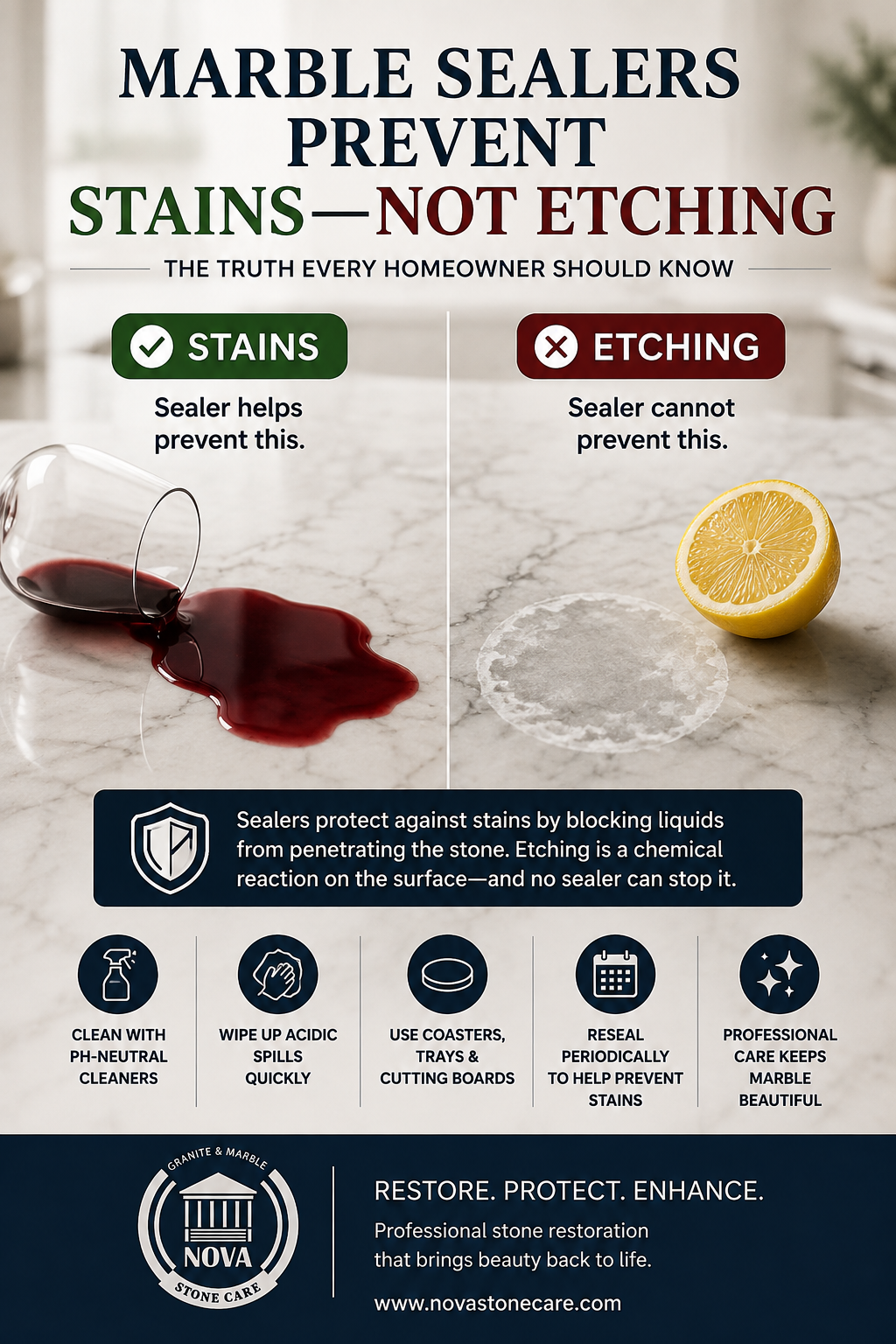
Marble Sealers Prevent Stains—Not Etching: The Truth Every Homeowner Should Know
One of the biggest misconceptions we hear at NOVA Stone Care is that sealing marble will prevent future etching. It’s an understandable assumption. After all, if your countertops or floors have just been professionally restored and sealed, it seems reasonable to expect that they would now be protected from all types of damage.
The truth is a little different.
A quality marble sealer is an important part of maintaining natural stone, but it is designed to protect against stains—not etching. Understanding the difference can help you care for your marble properly and avoid unnecessary frustration.
What Does a Marble Sealer Actually Do?
Marble is a naturally porous stone. Without a quality penetrating sealer, liquids can soak into the stone and leave permanent stains.
A professional-grade impregnating sealer helps slow the absorption of liquids such as:
- Coffee
- Wine
- Cooking oils
- Juice
- Cosmetics
- Soap and personal care products
This gives you more time to wipe up spills before they penetrate the stone.
Sealing is one of the best ways to protect marble from staining, which is why every restoration project performed by NOVA Stone Care includes sealing when appropriate.
What Is Marble Etching?
Etching is completely different from staining.
Instead of a liquid soaking into the stone, etching occurs when an acidic substance comes into contact with marble. Because marble contains calcium carbonate, acids react with the surface and leave behind dull spots or marks.
Common causes of etching include:
- Lemon juice
- Vinegar
- Wine
- Orange juice
- Tomato sauce
- Citrus-based cleaners
- Bathroom cleaners
- Some cosmetics and perfumes
No penetrating sealer can stop this chemical reaction.
Why Doesn’t Sealer Prevent Etching?
This is probably the most common question we receive.
A penetrating sealer works below the surface of the stone by filling microscopic pores. It helps reduce liquid absorption, but it does not create a protective coating on top of the marble.
Acids react with the surface immediately. Since the chemical reaction happens on the surface—not inside the pores—the sealer cannot prevent etching.
This is true for all natural marble, regardless of the brand of sealer used.
Does Professional Restoration Make Marble More Likely to Etch?
No.
Professional marble restoration does not make your countertops or floors more susceptible to future etching.
During restoration, the damaged surface is mechanically refinished using professional diamond abrasives. This process removes scratches, etch marks, and dull areas while restoring the stone to its original finish. The restoration does not change the composition or durability of the marble.
Some homeowners feel their marble is etching “more than before” after restoration, but that isn’t actually the case.
Before restoration, years of scratches, old etch marks, and general wear often hide new damage. Once the marble has been restored to a smooth, uniform finish, any new etching becomes much easier to notice because it contrasts with the surrounding polished surface.
In other words, the marble isn’t etching more—it simply looks more noticeable on a beautifully restored surface.
Why We Still Recommend Sealing Every Marble Surface
If sealing doesn’t prevent etching, why do we recommend it?
Because staining and etching are two completely different types of damage.
While etching cannot be prevented with a sealer, staining often can.
A properly sealed marble surface is much less likely to absorb oils, food, beverages, and other liquids that can permanently discolor the stone.
Think of sealing as insurance against stains—not against acids.
How to Keep Your Marble Looking Its Best
The best way to preserve your marble is through proper daily care.
We recommend:
- Clean with a pH-neutral stone cleaner specifically formulated for natural stone.
- Wipe up acidic spills as soon as possible.
- Avoid vinegar, bleach, citrus cleaners, and abrasive cleaning products.
- Use cutting boards when preparing food.
- Place coasters under beverages.
- Reseal the stone periodically, depending on usage and the type of marble.
These simple habits will help extend the life and beauty of your marble.
Trust the Experts at NOVA Stone Care
At NOVA Stone Care, we believe that educating our customers is just as important as providing exceptional craftsmanship.
Our goal is not only to restore the beauty of your natural stone but also to help you understand how to maintain it for years to come.
If your marble countertops, floors, showers, or vanities have become dull, scratched, or etched, professional restoration can bring them back to life. And while sealing is an essential final step, knowing what it can—and cannot—do will help you enjoy your marble with confidence.
If you have questions about caring for your marble or would like a free estimate for professional restoration, contact NOVA Stone Care. We’re always happy to help homeowners throughout Northern Virginia, Washington, DC, and Maryland restore the natural beauty of their stone.
Contact NOVA Stone Care today for a free estimate and let us restore the natural beauty of your marble countertops. | Visit: www.novastonecare.com
For top-quality stone care products trusted and used daily by our team, visit https://mbstone.com/

Comments are closed.