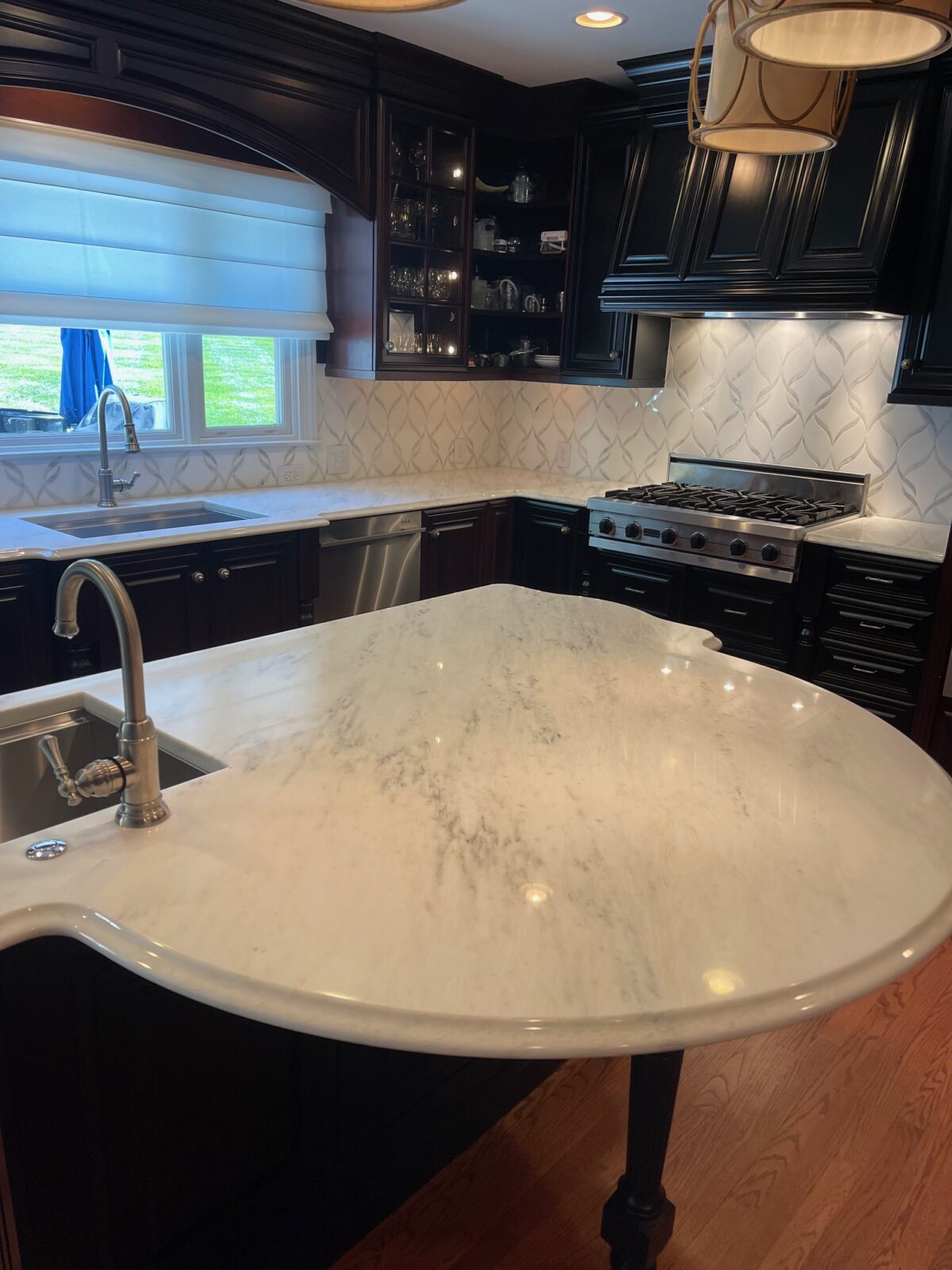

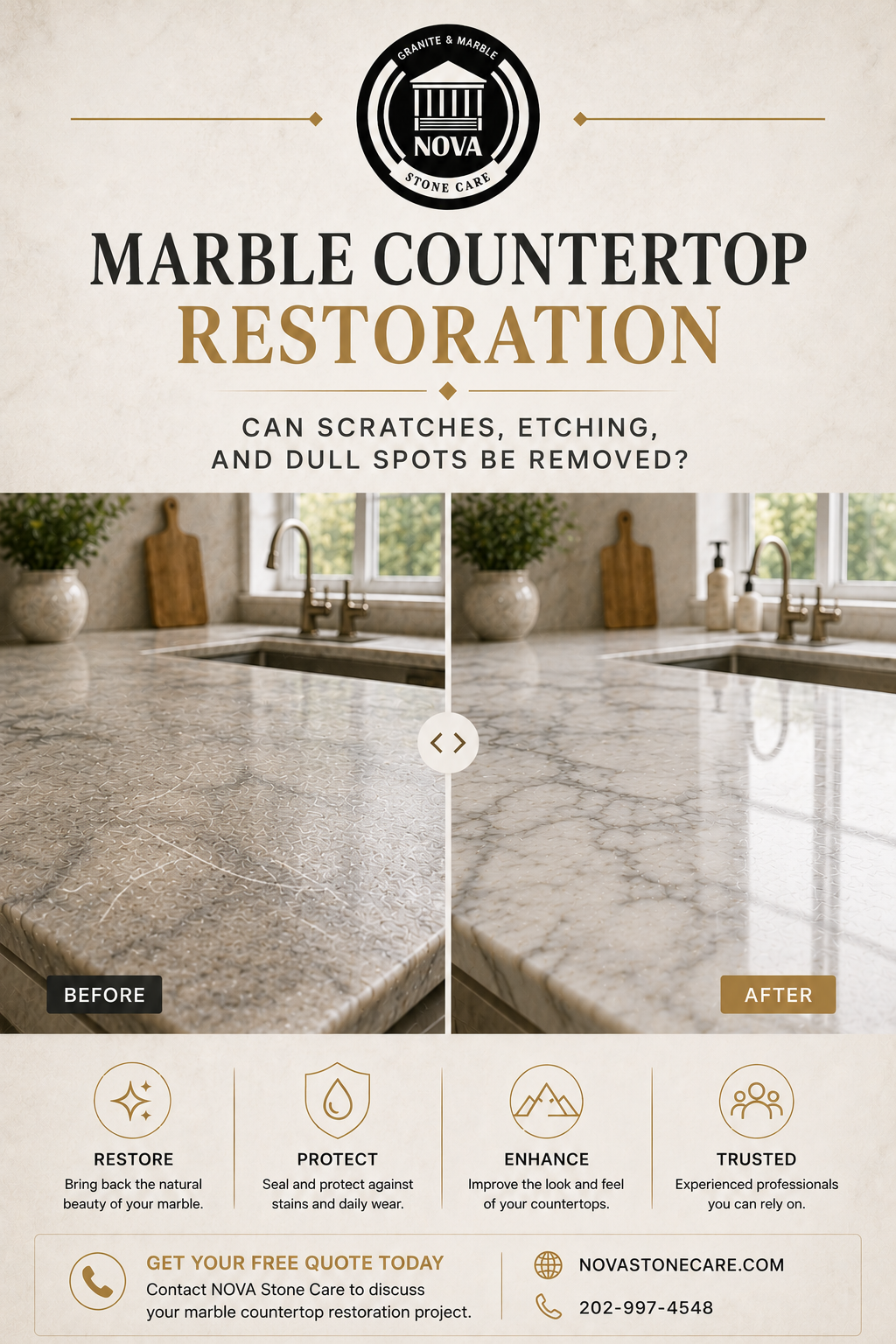
Marble Countertop Restoration: Can Scratches, Etching, and Dull Spots Be Removed?
Marble countertops are beautiful, but they are also sensitive to everyday wear. Over time, marble can develop scratches, etch marks, dull spots, and other imperfections.
These problems are especially noticeable on polished marble. Even a small dull area can stand out against the surrounding glossy surface.
One of the most common questions homeowners ask us is whether this damage can be removed. Many also wonder if their countertops need to be replaced.
The good news is that replacement is often unnecessary.
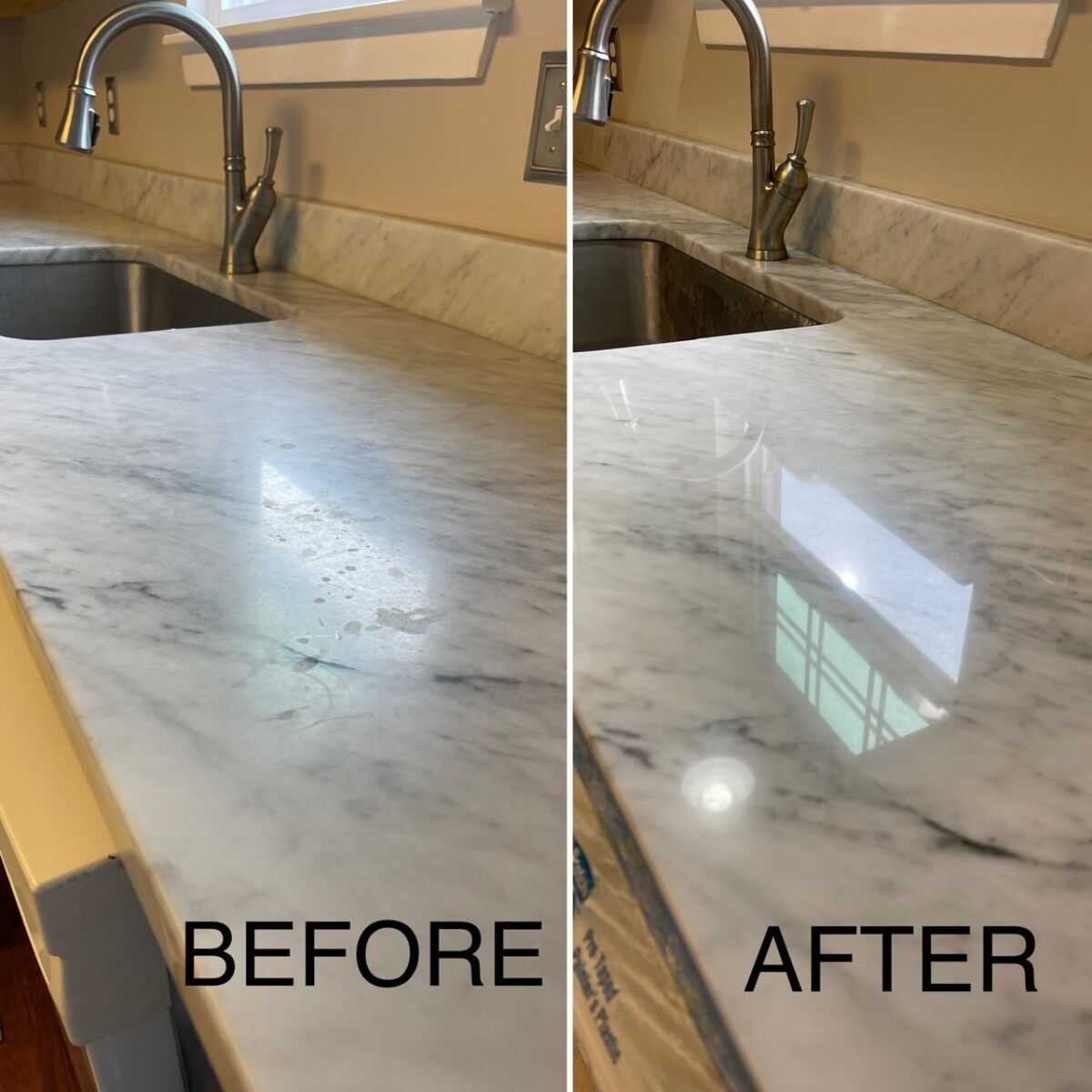
Professional marble countertop restoration can dramatically improve the appearance of worn or damaged stone. In many cases, it can restore a smooth and consistent finish.
However, the final result depends on the type and depth of the damage.
Here is what homeowners should know about restoring scratched, etched, and dull marble countertops.
What Is Marble Countertop Restoration?
Marble countertop restoration is the process of mechanically refinishing the surface of the stone.
The goal is to remove or reduce scratches, etching, dull areas, and other signs of wear.
This process is very different from simply cleaning the marble or applying a sealer.
When the surface itself is damaged, professional diamond abrasives are used to hone and refine the stone. The marble is usually refinished with progressively finer diamond grits.
Depending on the original finish, the marble can be restored to a honed or polished appearance.
A honed finish has a smooth, matte or low-sheen appearance. Polished marble has a higher-gloss and more reflective finish.
The goal is to restore a smooth and consistent appearance across the work surface.
Can Scratches Be Removed From Marble Countertops?
In many cases, yes.
Light and moderate surface scratches can often be removed through professional diamond honing.
During the honing process, diamond abrasives carefully refine the surface of the marble. This removes a very small amount of stone.
As the damaged surface is refined, many scratches can be removed or significantly reduced.
However, the depth of the scratch makes a major difference.
Light surface scratches may disappear completely during restoration. Deeper scratches may improve significantly but remain somewhat visible.
Very deep scratches and gouges can be more difficult to remove.
Removing them completely may require taking away too much surrounding stone. This could create an uneven surface or unnecessarily alter the countertop.
For this reason, some deep scratches may remain after restoration.
The goal is to achieve the best possible improvement without compromising the integrity of the stone.
Can Etching Be Removed From Marble?
Etching is one of the most common problems we see on marble countertops.
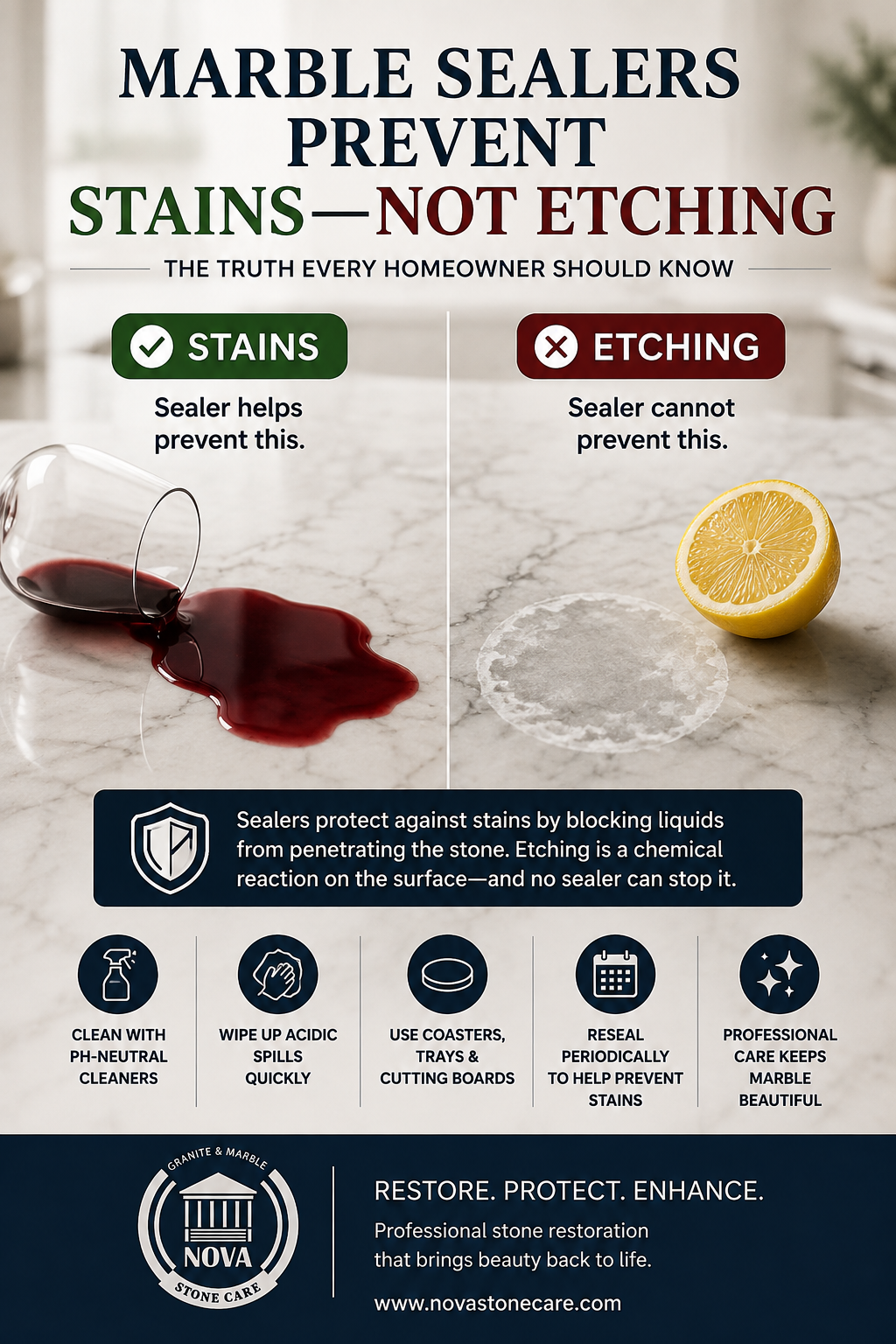
Etch marks are also frequently mistaken for stains.
They may appear as dull spots, light-colored marks, rings, or splash marks. They are often more noticeable when light reflects across the countertop.
Etching occurs when an acidic substance reacts with the marble.
Common causes include lemon juice, vinegar, wine, certain foods, and acidic household cleaning products.
This chemical reaction damages the finish of the stone.
If the etching is limited to the surface, professional honing can usually remove it. The damaged surface is refined until a more consistent finish is achieved.
However, some etching can be more severe.
If the damage extends deeper into the stone, it may not disappear completely. Removing deep damage could require excessive honing.
In those situations, some evidence of the etching may remain after restoration.
 Etching and Staining Are Not the Same
 Etching and Staining Are Not the Same
It is important to understand the difference between an etch mark and a stain.
Etching affects the finish of the marble. It is caused by a chemical reaction at the surface.
A stain occurs when a substance absorbs into the stone and causes discoloration.
Dark discoloration often indicates that something has penetrated into the marble.
Surface etching can often be addressed through professional honing. Deep stains are different.
If a stain has penetrated deeply into the stone, refinishing may not remove it.
This distinction is important when determining what marble countertop restoration can realistically accomplish.
Can Dull Marble Countertops Be Restored?
 Can Dull Marble Countertops Be Restored?
Yes. Dullness is one of the main reasons homeowners choose to have their marble professionally refinished.
Sometimes there is no single damaged area.
Instead, the entire countertop gradually loses its original appearance.
Years of everyday use can create small scratches, minor etching, and worn areas. Over time, these imperfections can make the surface appear cloudy or uneven.
Professional honing can remove much of this surface wear.
The marble is gradually refined until the surface becomes smoother and more consistent.
If the countertop originally had a polished finish, additional polishing can restore the desired shine.
If the countertop has a honed finish, the marble can be refined to restore its smooth, matte appearance.
Why Refinishing the Entire Area May Be Necessary
 Why Refinishing the Entire Area May Be Necessary
Homeowners sometimes ask us to repair only one small scratch or etch mark.
While localized repairs may be possible in certain situations, they do not always produce the best result.
This is especially true with polished marble.
A repaired spot may have a slightly different sheen than the surrounding stone. The difference can become more noticeable under natural or overhead lighting.
For this reason, a larger section may need to be refinished.
In some cases, refinishing the entire countertop area produces the most consistent appearance.
The goal is not simply to remove an individual mark. The restored area should also blend properly with the surrounding stone.
What Happens During Marble Countertop Restoration?
The restoration process usually begins by protecting the surrounding work area.
Plastic coverings, protective tape, and drop cloths are used to protect nearby surfaces.
The marble is then cleaned and evaluated before refinishing begins.
Professional diamond abrasives are used with water to hone the surface. The appropriate starting grit depends on the condition of the marble.
More severe damage may require starting with a more aggressive diamond grit.
Progressively finer abrasives are then used to refine the stone.
For polished marble, a polishing process follows the honing stages. This restores the appropriate level of shine.
For honed marble, the process stops at the appropriate grit to achieve the desired matte finish.
After restoration, the countertop is thoroughly cleaned.
An appropriate penetrating sealer can then be applied to help protect the marble against future staining.
It is important to remember that sealing does not prevent etching. A properly sealed marble countertop can still react with acidic substances.
What Marble Restoration Cannot Always Remove
Professional marble restoration can produce a dramatic improvement.
However, it does not mean that every imperfection will disappear.
Some damage extends too deeply into the stone to be safely removed.
This may include deep scratches, gouges, impact marks, natural fissures, and severe chemical damage.
Certain white spots or marks within the stone may also remain.
Dark stains that have penetrated deeply into the marble may not be removed through refinishing either.
Trying to eliminate every deep imperfection can require removing too much stone. In many cases, that would do more harm than good.
A professional restoration should improve the overall appearance while preserving the integrity of the countertop.
Homeowners should be made aware of these limitations before the restoration begins.
How Much Improvement Should You Expect?
Every marble countertop is different.
Countertops with surface scratches, etching, dull spots, and normal wear often respond extremely well to professional restoration.
In many cases, years of surface wear can be removed.
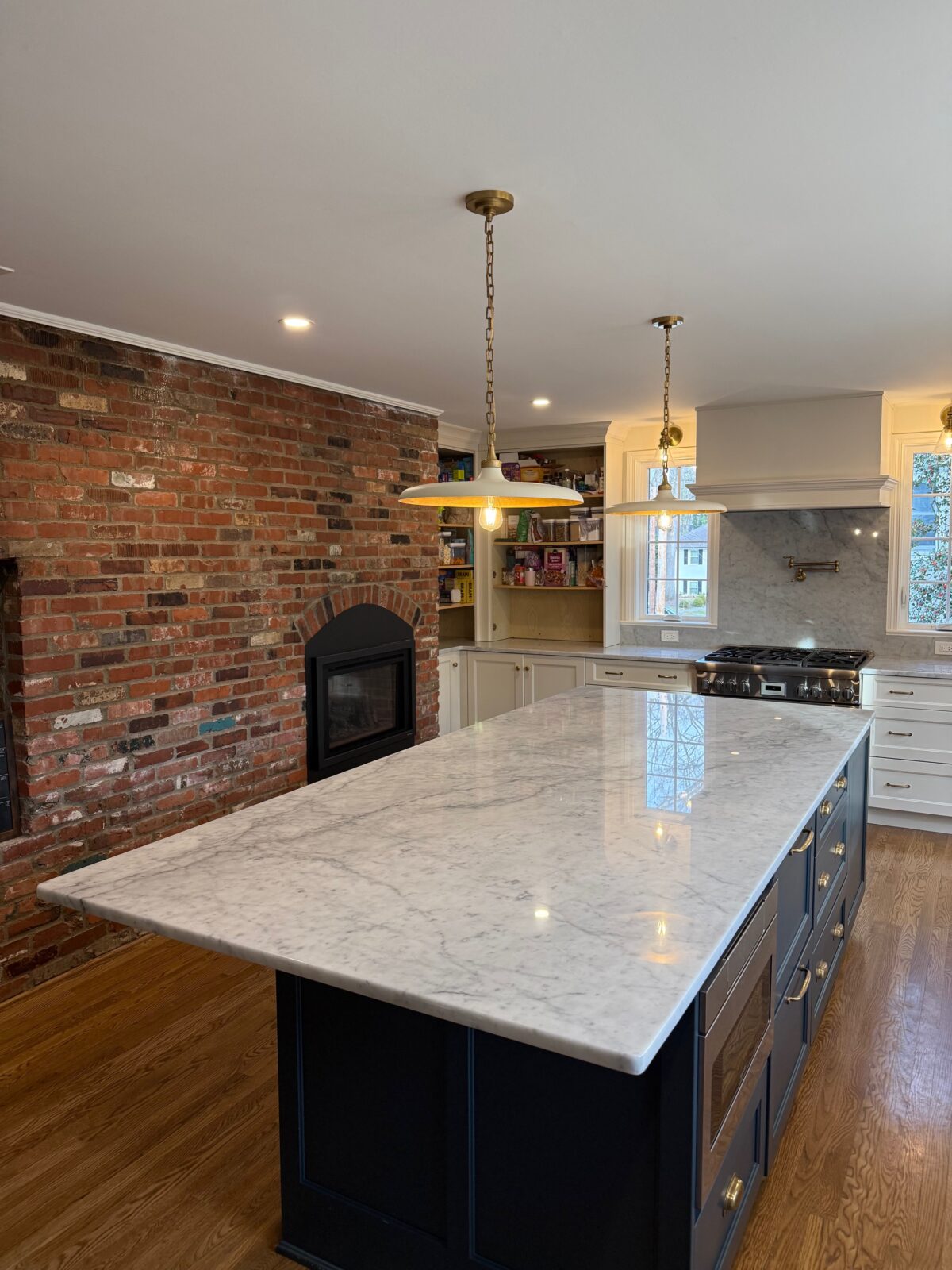
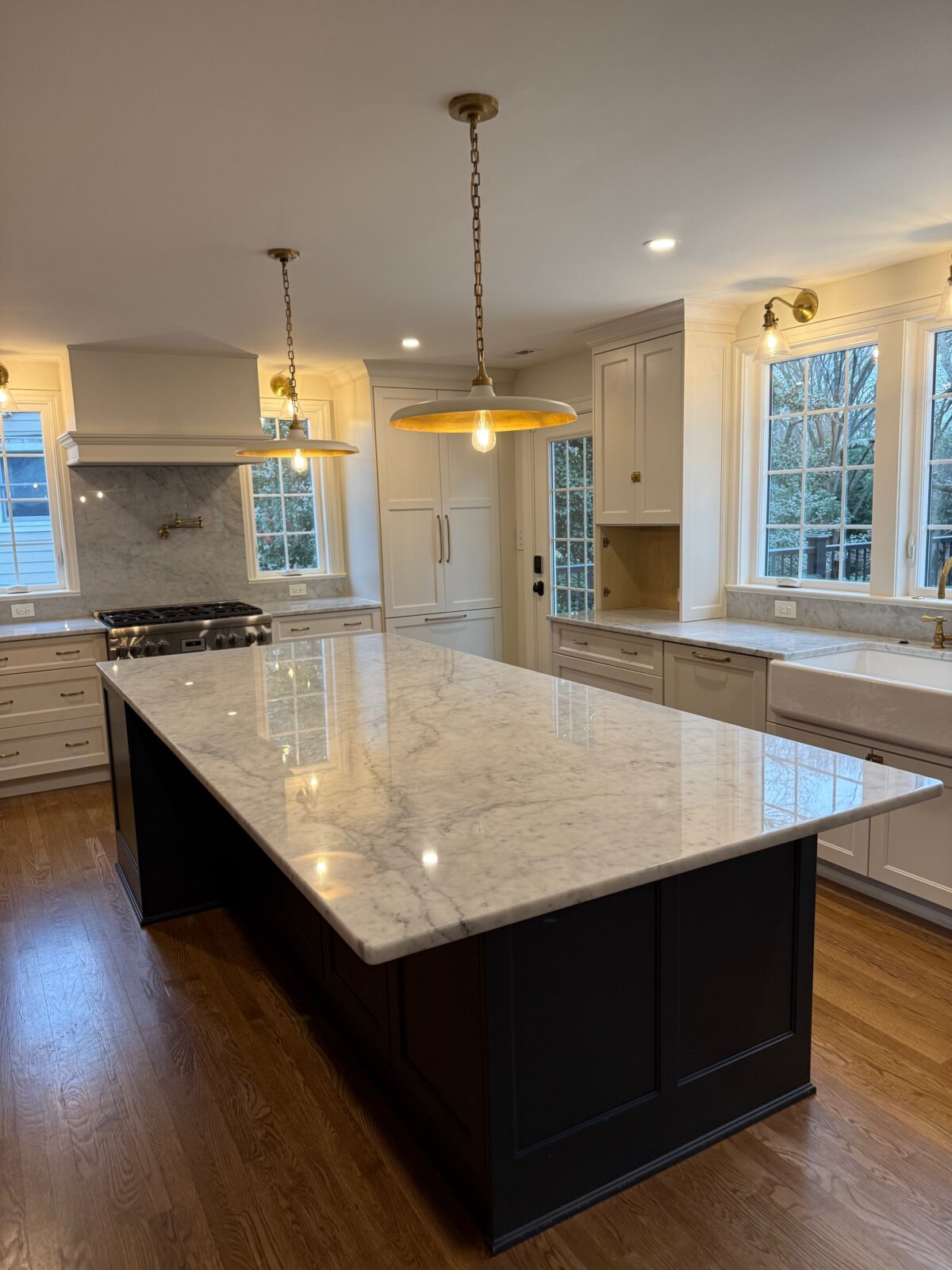
The countertop can look dramatically better without replacing the stone.
However, several factors can affect the final result.
These include the depth of the damage, condition of the marble, previous restoration work, and original installation.
Marble is also a natural material. Different stones can respond differently to the restoration process.
For that reason, realistic expectations are important.
The objective should be to achieve the best possible overall appearance without unnecessarily removing material from the stone.
Do Scratched, Etched, or Dull Marble Countertops Need to Be Replaced?
Not necessarily.
If you still like your marble, restoration should often be considered before replacement.
Scratches, etching, and dullness usually affect the surface finish. They do not necessarily mean the countertop itself has reached the end of its life.
Professional diamond honing and polishing can remove years of surface wear.
The process can often restore a smoother, cleaner, and more consistent appearance.
The key is determining which imperfections are at the surface. Deeper damage may improve but could remain visible.
A professional evaluation can help determine what results are realistically achievable.
Professional Marble Countertop Restoration in Northern Virginia
NOVA Stone Care specializes in professional marble and natural stone restoration throughout Northern Virginia and the surrounding DMV area.
We regularly restore marble countertops with scratches, etch marks, dull areas, and general wear.
Our approach begins with evaluating the condition of the stone. We then explain what can realistically be improved before beginning the restoration.
Professional diamond honing and polishing techniques are used to restore the best possible finish. At the same time, we avoid unnecessarily removing material from the stone.
If your marble countertops are scratched, etched, or dull, replacement may not be necessary.
Ready to Restore Your Marble Countertops?
If your marble countertops are scratched, etched, dull, or showing signs of wear, professional restoration may be the right solution. Contact NOVA Stone Care to discuss your marble countertop restoration project and find out what can realistically be improved.
Get Your Free Quote Today and let us help restore the natural beauty of your marble countertops.
For professional-quality stone care products trusted and used by our team, visit MB Stone Care.